
Embark
ON A Sensory
adventure and explore the beauty of Oregon’s best…
natural
Scents
Field Guide
Just as a birdwatcher learns to distinguish a “raptor” from a “songbird,” a Scent-Watcher learns to identify the mechanical behaviors of the atmosphere to interpret and describe what they are smelling. Use this glossary to expand your vocabulary, sharpen your own field observations, and enrich your travels in the state of Oregon.
The Language of the Air
I. THE PRIMITIVES (The “Species” of Scent)
Use these terms to identify the “raw scent materials” of a site.
- Brine: The sharp, electric “zip” of the ocean. A combination of salt, iodine (the medicinal, sea-spray chemical), and aerosolized kelp (seaweed that has been broken into a fine, breathable mist by crashing waves). It feels “blue” and metallic.
- Resin: The “sticky” signatures of the forest. Think of tree sap, juniper berries, or sagebrush. These are the plant’s natural defense chemicals—thick, sweet, and persistent. Their scent is often thick, sweet, and persistent.
- Loam: The “dark” scent of the earth. The smell of damp soil, fungal mycelium (the tiny, root-like threads of mushrooms), and decomposing forest floor. It feels “brown,” heavy, and grounding.
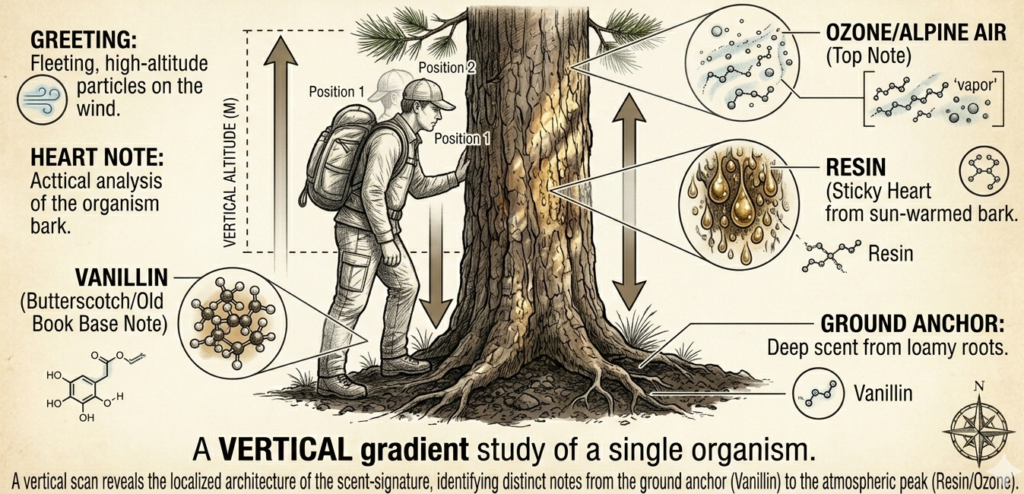
- Vanillin: A specific, sweet “butterscotch” or “old book” scent found in the bark of sun-warmed Ponderosa pines.
II. ATMOSPHERIC STATES (How Scent Moves)
Use these terms to analyze the wind and weather.
- The Surge: A high-velocity event where wind and waves physically “push” scent toward you.
- The Suspension: A state where moisture traps scent molecules and holds them in the air like a cloud.
- The Radiator: A state where solar heat “cooks” a landscape until it releases its scent.
- The Cold-Chain: A high-altitude state where thin, freezing air preserves a scent’s “crystalline” purity.
The following terms and information enable you to physically engage with the environment.
III. THE LAYERS (Sensory Architecture)
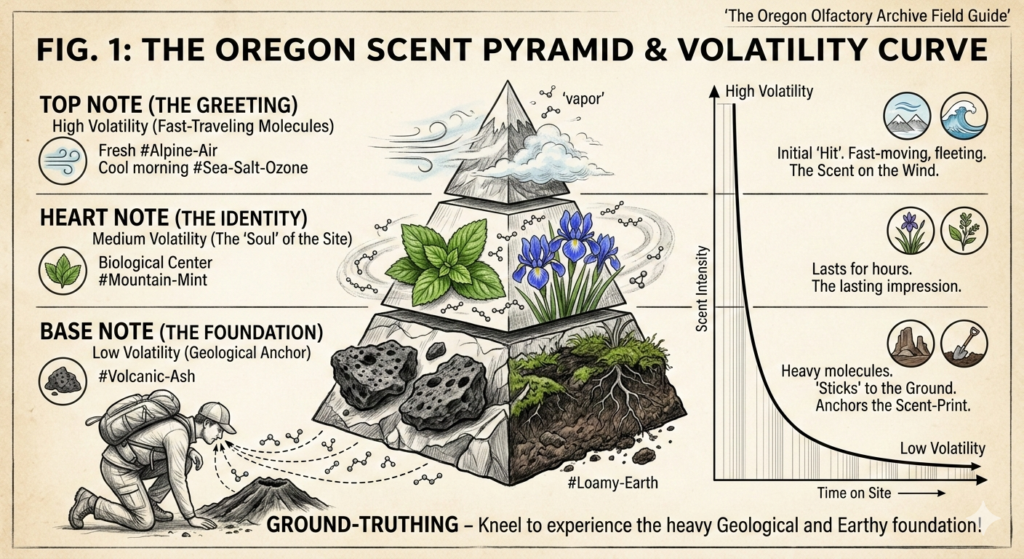
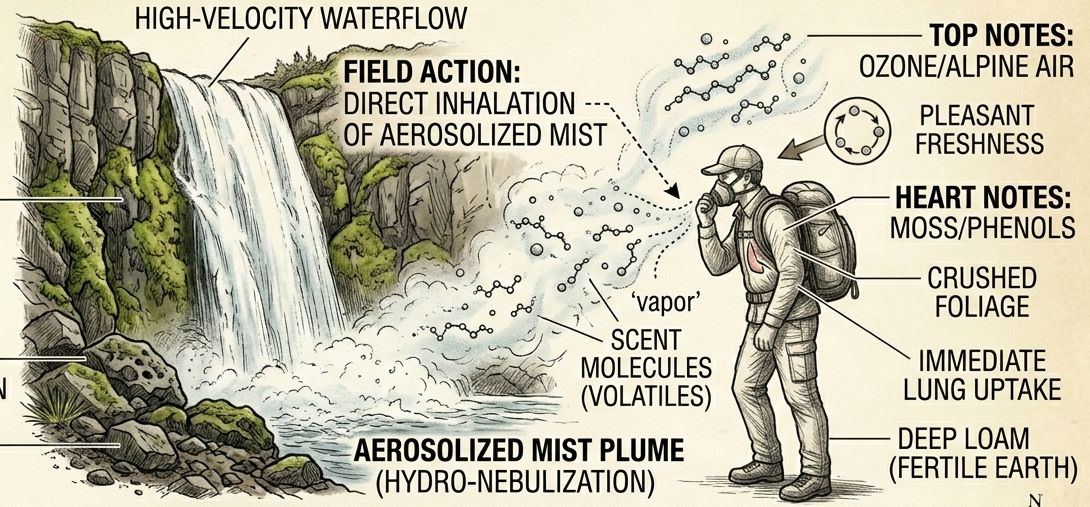
- Top Note (The Greeting): High-volatility molecules. These are the “sprinters” that hit the nose first but evaporate quickly (e.g., #Alpine-Air).
- Heart Note (The Identity): Medium-volatility biological centers. These define the “soul” of a site, such as the spicy green phenols (the plant’s aromatic compounds) of #Mountain-Mint.
- Base Note (The Foundation): Low-volatility geological anchors. These are heavy molecules that “stick” to the earth, your hair, clothing and skin, such as #BonfireSmoke.
IV. FIELD ACTIONS (Enhance Your Experience)
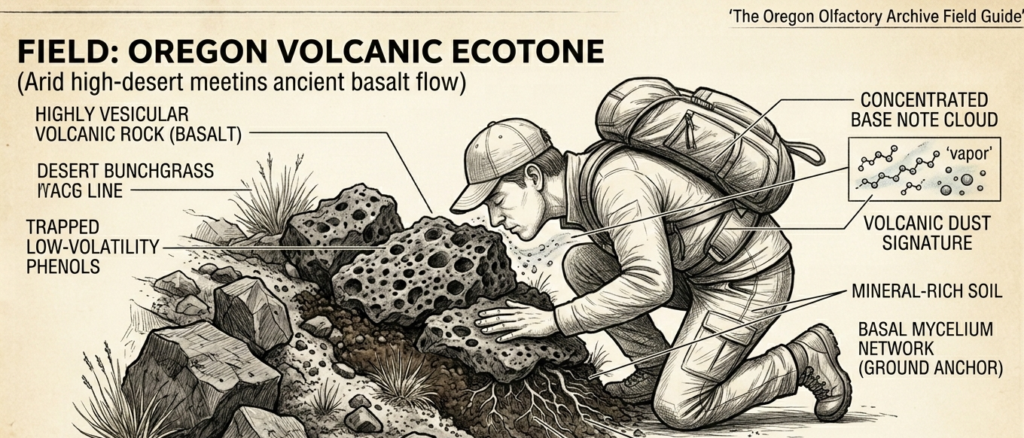
- Ground-Truthing: The act of kneeling or crouching to smell the soil or rocks directly. Because Base Notes are heavy, they hover in the first 12 inches of the air. If you stay standing, you miss the foundation of the scent-print. If you don’t get low, you’ll miss a scent appreciation moment.
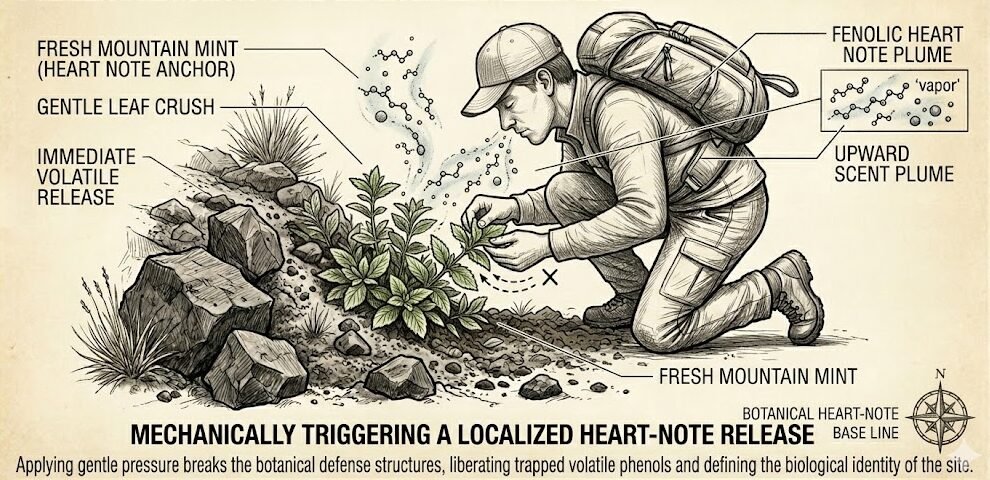
- The Manual Release: Using your hands to break the “scent-armor” of a plant. Take a fallen needle or leaf and roll it between your palms to trigger an immediate, localized Volatile Release. Rolling a fallen needle or leaf this way triggers an immediate release of the oils trapped inside. Just make sure the plant is not toxic! You wouldn’t want to hurt your skin experimenting out there.
- The Proximity Scan: Moving your nose along a vertical axis—from the roots of a tree up to the sun-warmed bark—to identify the scent gradient (the way the smell changes) of a single organism.
V. TECHNICAL FIELD TERMS
If you are wondering “Volatility what?”—here is the decoder ring:
- Volatiles: The physical molecules traveling through the air. Heat and movement make scents more “volatile.” Volatiles travel through the air and your nose catches.
- Thermal Activation: When the sun acts as a mechanical catalyst (a “starter”) to heat up plants and rocks until they release their scent.
- Hydro-Nebulization: When falling water (waterfalls/rain) breaks apart scent molecules and turns the air into a “breathable mist.”
- Molecular Extraction: The process used by #Native-Culinary-Botanical-Establishments to concentrate and release heavy-molecule resins through heat or distillation so that you can smell and taste them. Squishing/heating a plant to concentrate and release heavy-molecule resins or phenols (spicy compounds).
- Petrichor: The scent that occurs the exact moment rain hits dry, volcanic soil, pavement or stones, releasing trapped gases.
VI. DESCRIBING THE EXPERIENCE (The Texture)
- Sharp / Biting: A scent that “stings” or tingles the top of the nostrils (e.g., the high-acid “zap” of Sea Salt).
- Round / Enveloping: A scent that feels like it is “hugging” you; smooth, balanced, and without “edges” (e.g., the soft, damp smell of Moss).
- Fixed: A scent that stays in your hair or clothes long after you leave; an indicator that the heavy molecules have bonded to them until washed out.
- Fleeting: A “rare sighting”—a scent that vanishes the moment the wind shifts.
- Scent Witness: A person (you!) who documents the air at a specific moment to generate a #Proustian-Memory-Lock (the moment a smell creates a permanent emotional memory).
VII. ATMOSPHERIC WINDOWS (Best Times To Visit)
- The Morning Rise (Dawn–9:00 AM): Humidity is high. Moisture “traps” scent molecules near the ground, making them heavy and intense.
- The Heat Release (2:00 PM–4:00 PM): Sun-activation happens and resins to “boil” off the bark and broadcast into the wind.
- The Evening Settle (Sunset–Dusk): Temperature inversion occurs. As the air cools, the “scent ceiling” drops, pressing the smells down into the trails.
VIII. THE SAFETY PROTOCOL (FIELD VIGILANCE)
Olfactory exploration requires a higher degree of environmental proximity than hiking. When you “Ground-Truth,” you are placing your face and hands into the habitat of local hazards.
I. THE BOTANICAL DISCIPLINE (ID BEFORE INHALATION)
The most critical rule for a Scent-Watcher: Never touch or deeply inhale any plant you cannot positively identify.
- The “Scent-Watcher’s Gap”: Many toxic plants release volatile compounds only when crushed. If you use a Manual Release on the wrong species, you may absorb toxins through the skin or lungs.
- The Look-Alikes: * Wild Carrot vs. Poison Hemlock: Hemlock (Conium maculatum) is common in Oregon. It has purple splotches on the stem and is lethal if touched or inhaled in high concentrations.
- Cow Parsnip vs. Giant Hogweed: Both cause phytophototoxicity. If the sap gets on your skin and hits the sun, it causes severe, third-degree chemical burns.
Essential ID Apps for the Field:
Use apps and digital tools to ID plants with discretion. When in doubt, it’s wisest to move on to something safer.
- PictureThis: Highly accurate AI botanical recognition. Use to identify over 10,000 types of plants, flowers, trees, and shrubs with over 98% accuracy.
- iNaturalist (Seek): Crowdsourced data used by scientists; excellent for Oregon-specific invasive species.
- Oregon Wildflowers App: Specifically tuned to the regional flora of the Pacific Northwest.
- Google Image Search: Checks search results for look-a-like images and reports the results to you.
II. GEOLOGICAL & AQUATIC HAZARDS
The Coast: The “Never Turn Your Back” Rule
Oregon’s coastline is beautiful but high-energy.
- Sneaker Waves: Large, powerful waves that appear without warning. They can pull a “Ground-Truthing” explorer into the surf in seconds. Always face the ocean.
- Unstable Cliffs: Coastal sandstone and mudstone are prone to “sloughing.” Never stand on the edge of a cliff to catch a sea-spray scent; the ground beneath you may be hollow.
The Rivers: The Cold-Water Shock
Oregon’s mountain streams (like the Deschutes or McKenzie) stay dangerously cold year-round.
- Slippery Basalt: Wet volcanic rock is slicker than ice. A fall into a fast-moving current while trying to reach a “Hydro-Nebulization” zone can lead to immediate hypothermia or drowning.
III. THE ODORANT DOS & DON’TS
| Safe to Touch & Smell | DO NOT Touch or Deep-Inhale |
| Conifers: Pine, Fir, Cedar, Spruce (Resins are generally safe). | Poison Oak: Common in canyons. Inhaling smoke from burning poison oak can be fatal. |
| Culinary Herbs: Wild Mint, Sagebrush, Yarrow. | Fungi: Many Oregon mushrooms (like the Galerina) are toxic. Smell impact of scent from a distance; do not handle. |
| Basalt/Geology: Sun-warmed rocks and dry volcanic soil. | Stagnant Water: Blue-green algae (Cyanobacteria) in lakes can produce neurotoxins. |
IV. GROUP SAFETY & LOGISTICS
- The Buddy System: Never explore off-trail alone. A simple ankle sprain while “Ground-Truthing” in a remote canyon becomes a life-threatening event without a witness.
- For Teachers & Tour Guides: * Establish a “No-Crush” zone for children until you have vetted the plants.
- Ensure all participants carry Technu (poison oak cleanser) and a basic first-aid kit.
- For Couples & Soloists: Always leave a “Scent-Trail Plan” (itinerary) with a friend before entering areas without cell service.
IX. THE SCENT WITNESS LOG
This final section is where the data meets the memory. Every expedition should be recorded to track the “shifting baselines” of Oregon’s ecology.
“A Witness is not merely an observer; they are a documentarian of a disappearing moment.”
Official Field Entry Template
Safety Clearance: (Species ID confirmed? Hazard check complete?)
Location Coordinates: (GPS or Trailhead name)
Atmospheric State: (Surge, Radiator, Suspension, or Cold-Chain?)
Dominant Primitive: (Brine, Resin, Loam, or Vanillin?)
Field Action Performed: (Ground-Truthed, Manual Release, or Proximity Scan?)
Curator’s Note: The above observations are based on the behavior of Terpenes and Esters—natural organic compounds produced by Oregon’s flora that react to thermal and barometric shifts.